Behavior09 September 2026
Cat Feather Toys: Why a Chase Is Not a Hunting Test
Cat feather toys can show what a cat chose in one play moment, but they cannot score hunting history, outdoor fit, or overall playfulness.
TextPetzette Editorial
Read5 Min
Evidence status
Source-backed editorial
- Evidence record
- 5 claim cards linked to 7 documented sources.
- Independent expert review
- Not commissioned. Petzette Editorial is responsible for the published wording.
- Source record checked
- 09 September 2026
- Scope
- General guidance. Individual animals and circumstances can differ.
Cat feather toys invite a tempting shortcut. If a cat chases the lure, a caregiver may read that as proof of a strong hunting instinct. If the cat watches without moving, the reaction may be labeled boredom, laziness, or a problem to solve. Neither conclusion is supported by one play moment.
The safer first-year decision is smaller: notice what this cat chose in this setting, then decide whether to offer a low-pressure play option. A feather-wand reaction is not a validated score for hunting history, outdoor access, or overall playfulness. This guide stays with that interpretation boundary. For choosing, inspecting, and storing toys, use the safer first-year cat-toy guide.
A feather-toy reaction is a play snapshot
A chase, pause, sniff, or walk-away describes an observable response to one toy, one movement pattern, and one moment. It does not tell you the complete history behind the cat, what they do outside the room, or what they feel internally. It also should not be used as a home test for health, personality, welfare, fear, or aggression.
That boundary is grounded in a 2026 study by Chung and colleagues in Behavioural Processes. The researchers recruited 87 cats in the United States and used standardized, repeated feather-wand trials. Their measurements showed consistent individual variation in a composite interest score, but the score had no significant connection with reported outdoor access, hunting history, usual home-play frequency, or caregiver-rated playfulness.
The study is useful, but its design matters. It examined a repeated, standardized measure and compared it with reported factors. It did not validate a one-off household test. A finding of no significant connection in that sample is not proof that no relationship could exist across all cats, settings, or tasks. It is a reason to avoid turning a quick reaction into a confident classification.
Keep play response and prey returns separate
Another paper can sound related while asking a different question. In a controlled, replicated household study published by Cecchetti and colleagues in Current Biology in 2021, homes that introduced daily object play recorded 25% fewer animals captured and brought home relative to the controls and the pre-treatment period.
That is an intervention result about reported animals brought home. It did not test whether an individual cat’s response to a feather wand predicts hunting history or future prey capture. The two studies are not a contradiction: one examined an association between a standardized toy-interest measure and reported factors; the other examined what followed a household play intervention.
So do not use the 2021 finding to promise that a particular amount of wand play prevents predation, and do not use the 2026 finding to conclude that ordinary play is meaningless. The evidence supports a narrower rule: keep a cat’s play choice, hunting questions, and outdoor-access decisions in separate lanes.
What to do when your cat chases—or ignores—the toy
Use the reaction as feedback about the session, not a score about the cat.
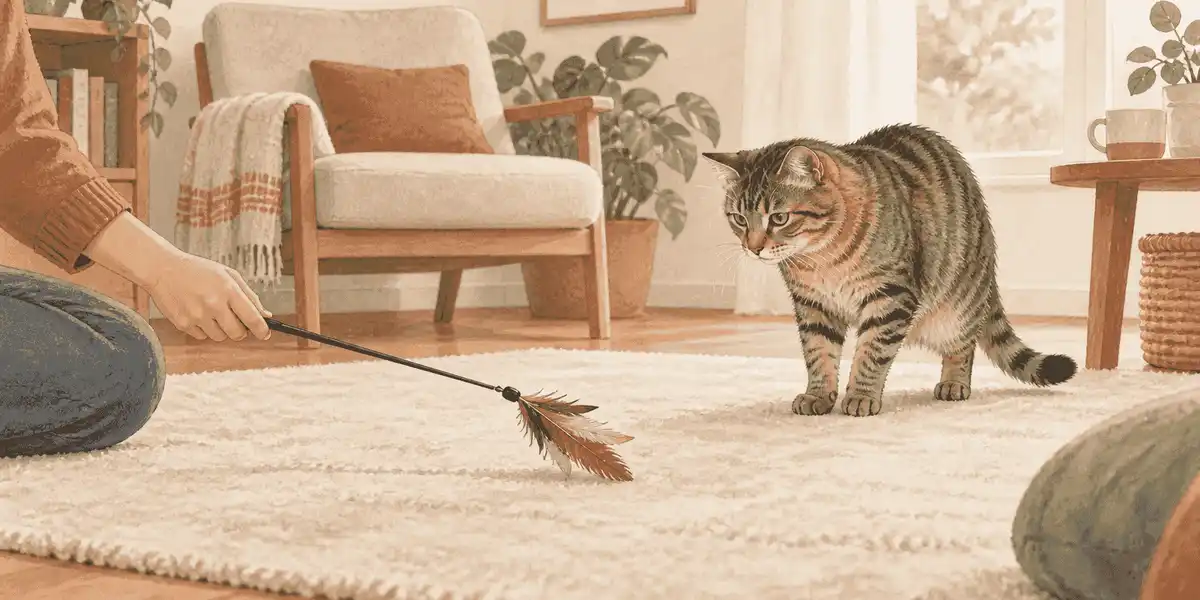
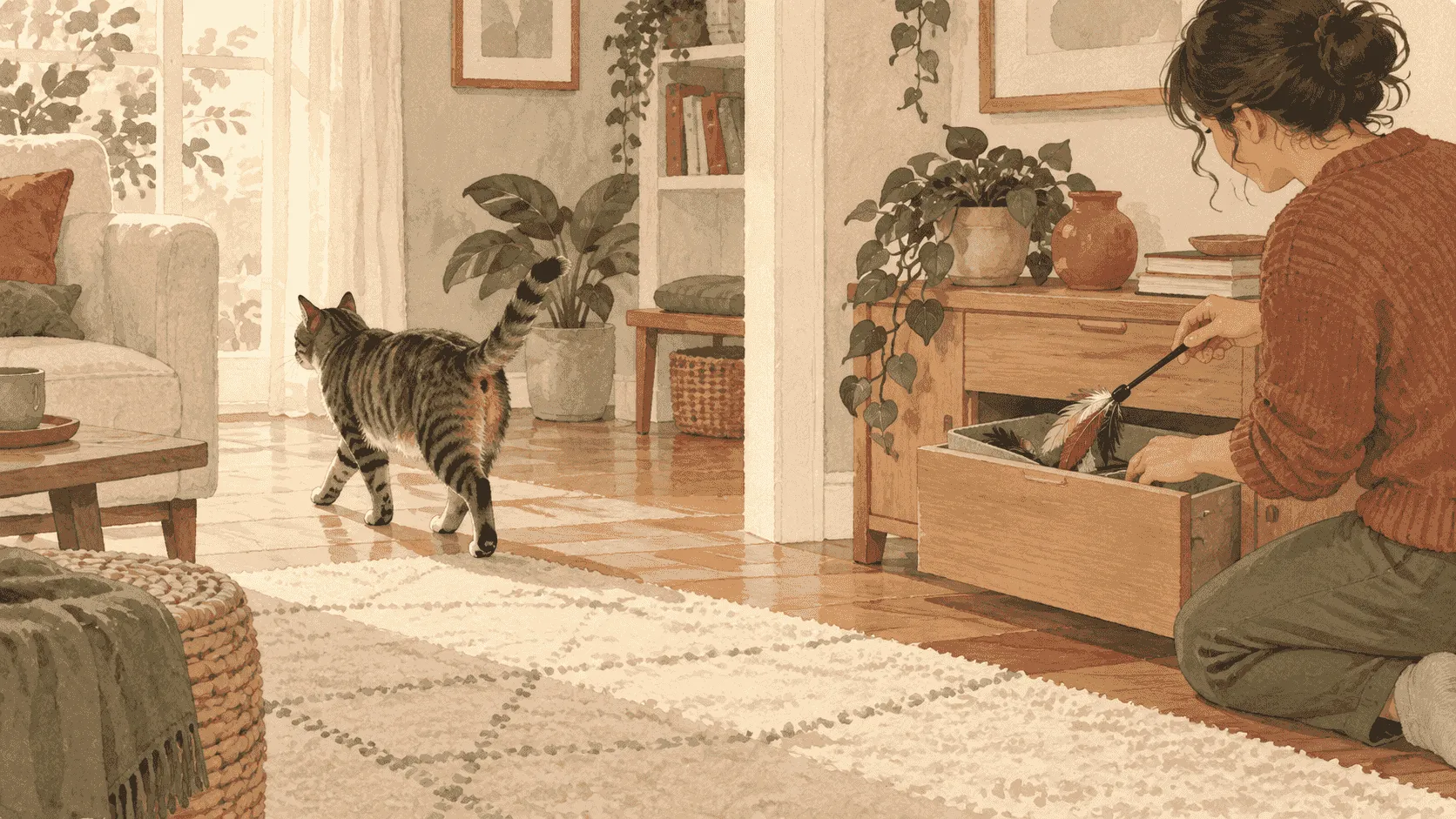
- If your cat approaches or chases: let the cat choose the pace. A supervised physical toy can provide a way to stalk, pounce, and sometimes catch an object. Keep the target away from hands and stop trying to make the reaction bigger once the cat has had enough.
- If your cat watches or ignores it: do not repeat the movement until you get a result, pressure the cat to engage, or assign a label such as bored or unwell. Offer another safe option in another moment, or accept that this toy was not useful right then.
- If your cat walks away: treat that exit as the end of the session. Cat Friendly Homes guidance recommends stopping pursuit and allowing the cat to reinitiate later. Walking away alone does not diagnose fear, pain, or rejection; it is a practical stop signal for this interaction.
The same approach applies if the cat changes their mind halfway through. A pause, turn, or retreat gives you a chance to lower the toy and leave a clear route. You do not need to finish the game or produce a dramatic pounce for the play to count.
Keep toy safety separate from toy meaning
Feather toys often include a wand line, knots, or small attachments. Those features create a supervision and storage question, not an interpretation shortcut. Use string-type toys only while you are actively playing, inspect the line and lure, and put the toy and loose swallowable pieces out of reach when the session ends.
A 2023 Journal of Feline Medicine and Surgery retrospective study described 56 cats that underwent surgery for linear or discrete gastrointestinal foreign bodies. Surgical cases cannot tell you how likely one feather toy is to be swallowed or predict what will happen to a particular cat. They do support prevention: a loose string, unraveling feather, or detached part should not remain available as a solo toy.
Do not pressure a cat to repeat a reaction because you are trying to collect a score. The evidence card for this topic specifically warns against repeating, withholding, or framing voluntary play as a pass/fail test. A normal play choice is enough information for that moment. If you need a broader setup check, the whole-cat body-language guide can help you record posture, distance, movement, and the route away instead of isolating the chase.
When a play change needs professional help
The feather-wand question changes if play interest or play-related behavior is suddenly different, severe, or unusual for this cat. Cornell University College of Veterinary Medicine advises considering medical causes before treating aggressive behavior as a behavior-only problem. If pouncing or biting is directed at hands, move the toy target away from skin, end rough play, and avoid punishment.
Ask your veterinarian when the change is sudden, persistent, severe, or accompanied by signs of pain or illness. A toy reaction cannot clear a health concern, establish outdoor suitability, or tell you what treatment is needed. If a swallowed string or toy part may be involved, contact a veterinary clinic for direction rather than pulling visible material or waiting for a home test.
A three-question feather-toy check
Before you interpret the next play moment, ask:
- What did my cat actually do? Record approach, chase, pause, catch, turn-away, or exit, plus the setting and what happened afterward.
- What am I adding to that observation? Remove claims about hunting history, outdoor access, personality, health, or a required play duration unless you have separate evidence for that question.
- What is the smallest safe next step? Offer supervised, catchable play if the cat chooses it; stop when the cat leaves; and call your veterinarian when the pattern is new, severe, unusual, or linked with wellbeing.
Cat feather toys can be useful objects for a voluntary play moment. They are not a household hunting test. Let the cat’s choice guide the next interaction, while larger questions about safety, welfare, health, and outdoor access stay where the evidence for them belongs.
Sources
Petzette's claim cards for this article point to the following scientific, veterinary, or animal-welfare sources.
- Cat Feather-Wand Response Is Not A Validated Hunting Score: Cross-source published feline-behaviour evidence note. It supports one narrow interpretation boundary: a cat's response to a feather wand is not a validated household score for reported hunting history, outdoor-access status, or overall playfulness. It does not establish an outdoor-access decision, wildlife-risk estimate, actual-predation measure, play dose, personality label, welfare assessment, or health assessment.
- Chung HJ, Ma Li C, Moody C, Sih A. *Utilizing citizen science to assess consistent individual variation in play behaviour of the domestic cat, Felis catus.* Behavioural Processes. Electronically published 2026-08-18;242:105425. doi:10.1016/j.beproc.2026.105425. PMID:42612887.
- AAFP/ISFM Feline Environmental Needs Guidelines 2013: Peer-reviewed veterinary guidelines plus client-facing practice resource
- Surgical Gastrointestinal Foreign Bodies In Cats, 2009-2021: Peer-reviewed retrospective clinical study
Gollnick HR, et al. *Journal of Feline Medicine and Surgery*. 2023;25(6). doi:10.1177/1098612X231178140.
- Cat Friendly Homes: Playing With Your Cat: Veterinary-association caregiver guidance
- Cat Friendly Homes: Play Ends With The Cat's Choice: Veterinary-association caregiver guidance
- Cornell Cat Destructive Behavior, Play, And Scratching: Veterinary school feline behavior guidance
- Cornell Cat Play Aggression: Veterinary school feline behavior guidance