Health Signals15 October 2026
Are Petunias Toxic to Dogs? Check the Plant Label
Are petunias toxic to dogs? Match the plant label, separate added products, record a possible exposure, and know when to call a veterinarian.
TextPetzette Editorial
Read4 Min

Evidence status
Source-backed editorial
- Evidence record
- 3 claim cards linked to 3 documented sources.
- Independent expert review
- Not commissioned. Petzette Editorial is responsible for the published wording.
- Source record checked
- 15 October 2026
- Scope
- General information, not an individual diagnosis or treatment plan.
Part of the plant safety checklist
Are petunias toxic to dogs? If the plant label matches Petunia species, the ASPCA Animal Poison Control Center lists that named entry as non-toxic to dogs and cats. That is useful context, but it is not a universal answer for every flower that looks similar, every plant in a mixed arrangement, or every product sold with “petunia” in its name.
The practical first-year decision is therefore narrow: identify the plant, separate it from anything else that may be involved, and keep a possible exposure record. If the identity, material, timing, or your dog’s condition is uncertain, contact a veterinarian or animal poison-control service rather than trying to settle the question with a photograph or a home remedy.
For a wider home scan, use the plants toxic to cats and dogs checklist. This page stays with one named plant and the boundary around its classification.
Start With Petunia Species, Not Just a Flower Photo
The ASPCA entry identifies Petunia by the scientific name Petunia species and places it in the Solanaceae family. It lists the named entry as non-toxic to dogs, cats, and horses. The important word is “named.” The database result belongs to the plant record that matches the label; it is not a blanket clearance for an unknown flower, a lookalike, or every member of a broad plant category.
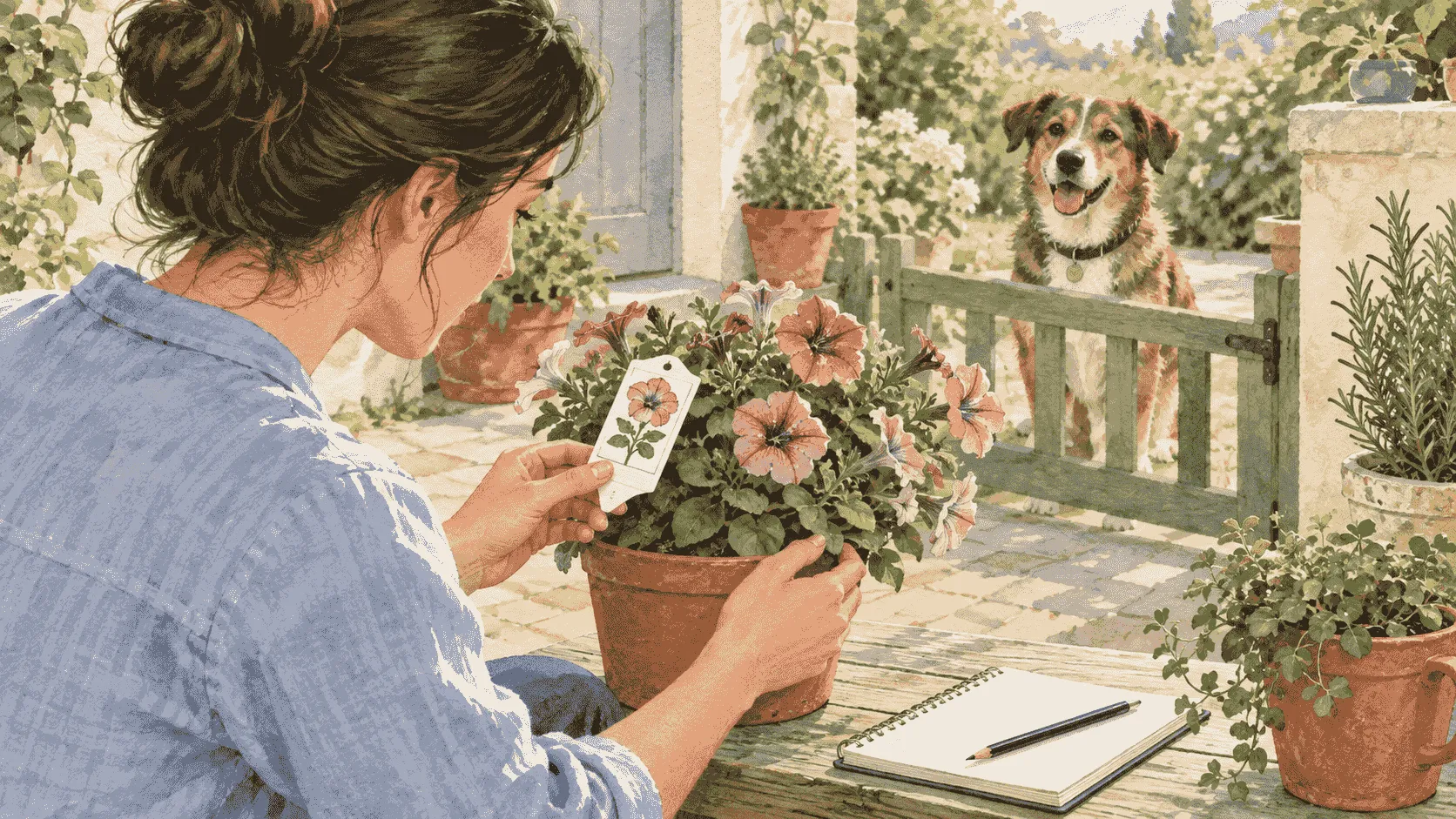
Before applying the answer, look for a nursery tag, pot label, receipt, plant record, or another reliable name. A clear photo of the whole plant can help a professional understand what you found, but appearance alone does not prove the botanical identity. If the label is missing, keep that uncertainty visible instead of borrowing the most reassuring result from a similar-looking flower.
What the Non-Toxic Listing Does—and Does Not—Say
“Non-toxic” is a poison-control classification, not a snack label. ASPCA’s plant-database overview notes that the list is not all-inclusive and that consuming plant material can still be associated with vomiting or gastrointestinal upset in dogs and cats. That boundary matters even when the plant name appears to match.
Do not use the listing to set a safe amount, decide that a dog should eat petunia, predict what will happen to one individual animal, or dismiss a current change. A petunia plant also does not answer questions about fertilizer, pesticide, potting material, a prepared food, an extract, or another flower sharing the same pot or bouquet. Those are separate exposure questions.
If a dog has reached the plant, move the plant and any nearby product out of access while you preserve the useful information. Keep the label, packaging, or a clear photo available. The goal is to make the next professional conversation more accurate, not to turn the classification into a home test.
Make a Short Petunia Exposure Note
Write down what you know without inventing precision:
- Plant identity: the exact label or the fact that the plant is unknown.
- Contact route: whether your dog may have chewed, swallowed, or brushed against it.
- Plant part and possible amount: flower, leaf, stem, soil, or another material, with “unknown” when needed.
- Time: when access may have happened and when you noticed it.
- Current changes: what is different now, including any digestive or other observations.
This is an information handoff, not a severity score. A short note helps keep the named plant separate from a garden product or a second flower in the same arrangement. If your dog is unwell, do not delay a call while trying to identify every missing detail.
Choose the Call Before Home Treatment
The American Veterinary Medical Association’s pet first-aid guidance says to keep product information available and not to induce vomiting or give medication unless a veterinarian or poison-control professional directs it. The ASPCA Petunia entry does not provide an amount threshold, a waiting period, a diagnosis, or an individual treatment plan.
Contact your veterinarian or an animal poison-control service when the plant identity, exposure, timing, or your dog’s condition is uncertain. Share the label or photo, the possible plant part, what else was nearby, and what you are observing. If the dog seems suddenly very unwell or has a serious breathing or swallowing change, seek urgent veterinary care rather than continuing a home investigation.
Add Petunia to the New-Dog Home Check
When a dog is learning a new home or garden, add reachable pots, dropped flowers, balconies, and garden products to the same label-first walk-through. Keep a simple photo record of plants before access happens. The point is not to make a perfect list; it is to make the exact name easier to find if a future question arises.
The answer to “are petunias toxic to dogs?” is precise: a correctly identified Petunia species entry is listed as non-toxic by ASPCA, but that classification does not make plant material edible or resolve an uncertain exposure. Match the label, keep the exposure facts together, and let a veterinarian or animal poison-control professional guide the next step when the story is not clear.
Sources
Petzette's claim cards for this article point to the following scientific, veterinary, or animal-welfare sources.
- ASPCA Petunia Poison-Control Classification: Animal poison-control plant-database record and public exposure guidance
- Spider Plant Poison-Control Classification And Name Check: Animal poison-control databases and veterinary manual guidance
- AVMA Pet First Aid: Poison Response Boundary: Veterinary-association first-aid brochure