Behavior26 July 2026
Why Do Cats Lick You? Pause, Read, Then Respond
Why do cats lick you? Use a pause-and-read check to decide whether to continue contact, give space, or call your veterinarian.
TextPetzette Editorial
Read4 Min
Evidence status
Source-backed editorial
- Evidence record
- 4 claim cards linked to 4 documented sources.
- Independent expert review
- Not commissioned. Petzette Editorial is responsible for the published wording.
- Source record checked
- 26 July 2026
- Scope
- General guidance. Individual animals and circumstances can differ.
Why do cats lick you? A lick can happen during a friendly interaction, but it is not a one-word translation of affection. It can also arrive while a cat is being held or stroked and wants more space. Your useful next move is to pause, read the whole interaction, and let the cat choose what happens next.
That small check matters when you are learning a new cat’s patterns. It helps you decide among three different actions: continue contact after the cat opts back in, stop and give space, or record a new persistent change for your veterinarian.
What a Cat Lick Can—and Can’t—Tell You
Blue Cross guidance reviewed in 2024 describes licking a person in more than one context. It may be part of affiliative social contact. The same guidance also notes that a cat may lick while being held or stroked but not want the handling to continue.
So the lick is evidence that licking happened—not proof of one motive. Avoid turning it into “my cat loves me,” “my cat is claiming me,” or “my cat is about to bite.” Instead, add three pieces of observable context:
- The setup: Did the cat approach you, or were you holding the cat in place?
- The whole body: Is the posture loose, or are the ears flattening and the tail beginning to swish or flick?
- The next choice: Does the cat lean back in, settle nearby, move away, or become more tense?
One moment may remain ambiguous. You do not need a perfect explanation before giving the cat room to choose.
Why Does My Cat Lick Me During Petting?
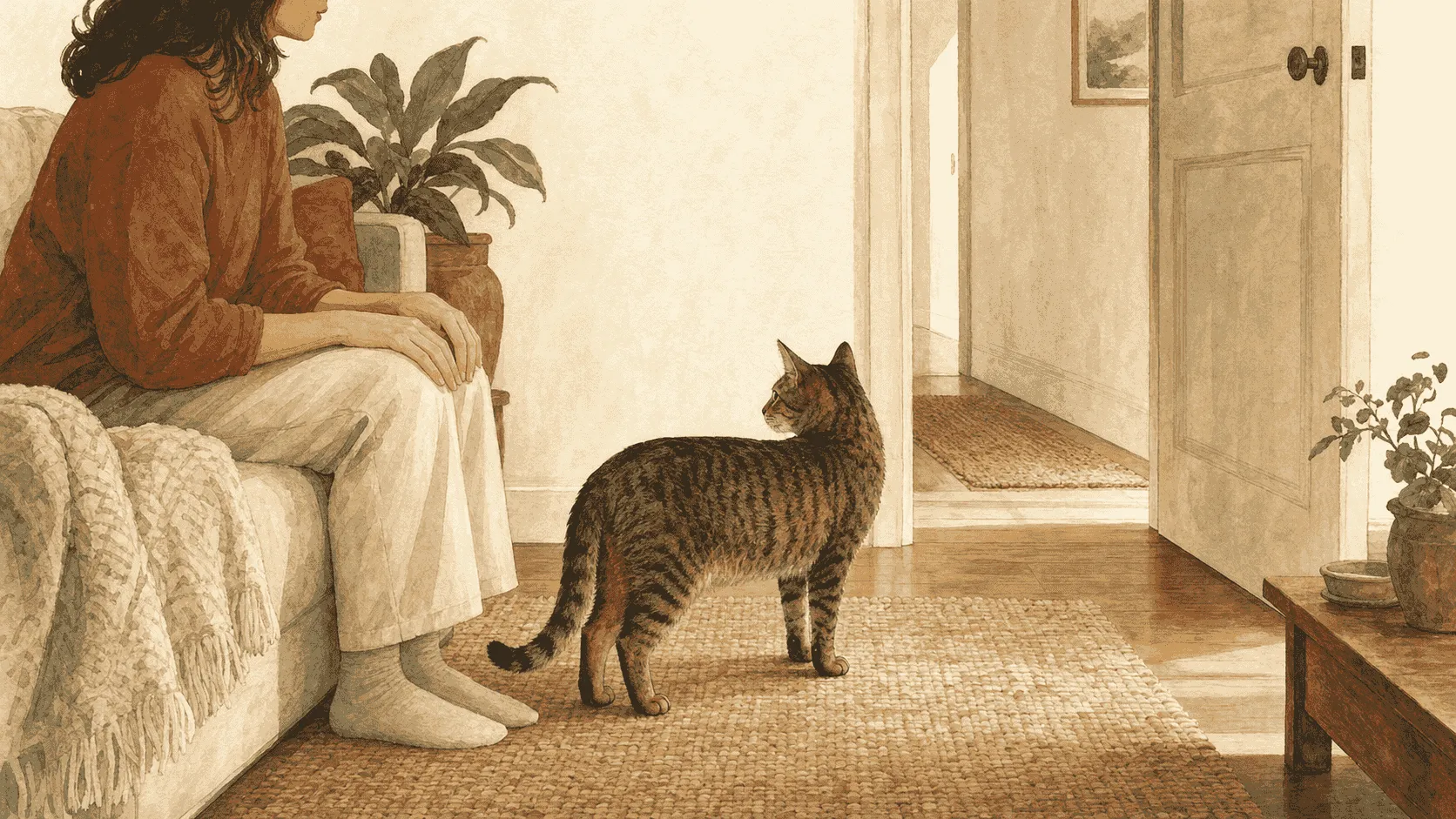
If the lick arrives while your hand is moving, stop your hand. Loosen any hold and make sure there is an open route away. Then watch without immediately offering another stroke.
The point is not to apply a magic timer. A 2021 study in Frontiers in Veterinary Science observed 100 well-socialized rehoming cats during interactions with members of the public. After people received brief training that combined choice and control, attention to body language, touch location, and pauses, the cats showed more affiliative behavior and less aggression and conflict-linked behavior. Because several parts of the interaction changed together, the study does not prove that pausing alone caused the difference.
It does support a practical approach: make contact optional, keep it predictable, and use the pause as an observation point. If the cat stays relaxed and clearly returns for contact, you can offer a short interaction. If the cat leaves or stays tense, let the pause become the end.
Use a Pause–Read–Record Check
Try this three-step decision aid the next time your cat licks you:
- Pause: Stop touch and release any restraint.
- Read: Notice posture, ears, tail, distance, and the action immediately after the lick.
- Record: If the pattern is new or confusing, note the time, duration, handling context, and anything else that changed.
If licking shifts into a nip during purring or petting, the guide to why cats bite while purring covers the bite-specific safety boundary. Do not continue touching to test whether another bite will happen.
For a newly adopted cat, compare the moment with that individual’s developing baseline rather than an internet personality label. The first 30 days with a new cat can help you keep routine, hiding, appetite, litter-box use, and interaction changes in the same settling-in picture.
When New Licking Needs a Veterinarian
One brief lick without other changes is not an emergency based on this evidence. The decision changes when licking people is new, repeatedly persists, or appears alongside a broader change.
Cats Protection guidance on a case of new, prolonged nighttime licking advised ruling out medical reasons with a veterinarian before assigning a behavioral explanation. That case does not show what causes nighttime licking in other cats. It gives a cautious escalation boundary: record the pattern and ask rather than diagnose from the clock.
Contact your veterinarian if the licking is a marked change, keeps recurring, or appears with pain signs, skin or coat changes, reduced appetite, unusual withdrawal, or another health change. If interactions escalate toward repeated biting or scratching, create distance without punishment and ask your veterinarian or a qualified cat behavior professional for an individual plan.
The answer to “why does my cat lick me?” may stay uncertain after one moment. Your next action does not have to. Pause the hand, read the whole cat, and give the next choice back to them.
Sources
Petzette's claim cards for this article point to the following scientific, veterinary, or animal-welfare sources.
- Blue Cross Guidance On Cats Licking People: Established animal-welfare guidance reviewed by a qualified animal behaviourist and veterinary surgeon
Blue Cross. “Why does my cat lick me?” Reviewed 23 May 2024; approved by Claire Stallard, ABTC-CAB, and Anna Ewers Clark, MRCVS.
- Cat Interaction Choice And Control Study 2021: Peer-reviewed controlled before/after human-training study
- Cats Protection Guidance On New Persistent Licking Of People: Established cat-welfare behaviour Q&A with an explicit veterinary boundary
Cats Protection. “Why does my cat miaow at me?” Behaviour Q&A featuring Nicky Trevorrow. Published 3 March 2017.
- AAFP/ISFM Feline Environmental Needs Guidelines 2013: Peer-reviewed veterinary guidelines plus client-facing practice resource