Health Signals03 September 2026
Are Amaryllis Toxic to Cats? Check the Label First
Are amaryllis toxic to cats? Learn how to match the plant label, record a possible exposure, and call a veterinarian before home treatment.
TextPetzette Editorial
Read4 Min
Evidence status
Source-backed editorial
- Evidence record
- 3 claim cards linked to 3 documented sources.
- Independent expert review
- Not commissioned. Petzette Editorial is responsible for the published wording.
- Source record checked
- 03 September 2026
- Scope
- General information, not an individual diagnosis or treatment plan.
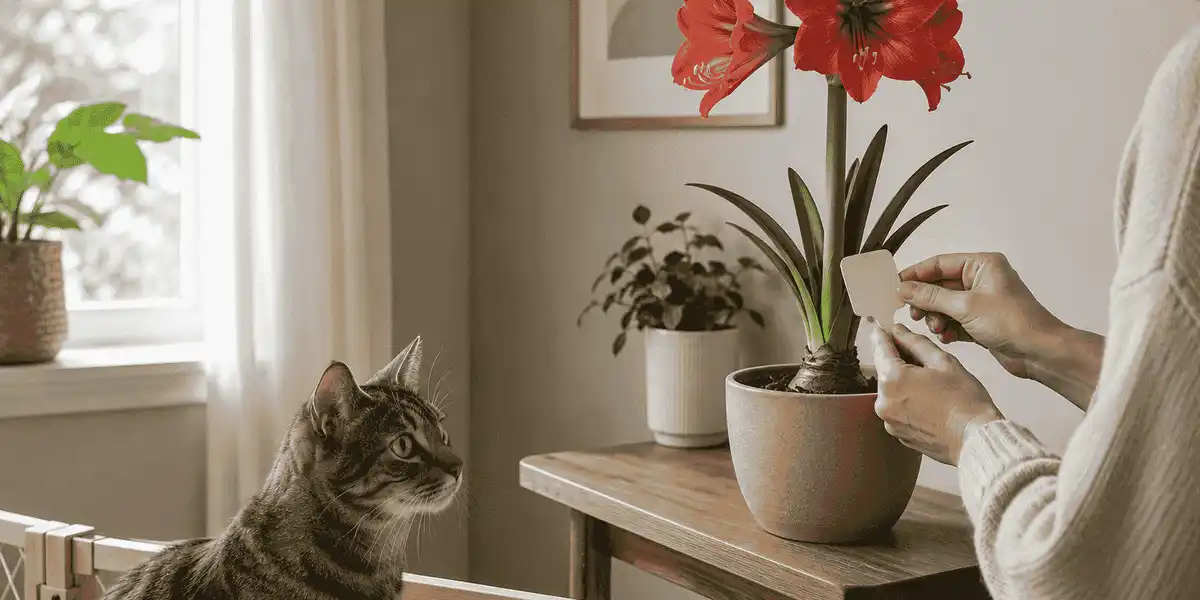
Are amaryllis toxic to cats? If the plant is the ASPCA Animal Poison Control Center’s named Amaryllis spp. entry, yes: it is classified as toxic to cats and dogs. The useful first-year decision is not to estimate whether a missing piece was “small.” It is to confirm the plant name, preserve the exposure details, and call a veterinarian or animal poison-control service promptly if your cat may have chewed or swallowed it.
The name can be confusing. The ASPCA entry lists Belladonna lily, Saint Joseph lily, Cape Belladonna, and Naked Lady among common names for amaryllis. The word “lily” alone does not identify an unknown plant or transfer one plant’s classification to another. Keep the label or botanical name beside you when you check the answer.
Match the plant to the ASPCA entry
Start with the plant record, not a photo-only guess. The ASPCA page identifies the entry as Amaryllis spp. in the Amaryllidaceae family. If the nursery tag, bulb packet, florist card, or garden record uses that name—or one of the listed common names—tell the professional exactly what it says.
If the label says another botanical name, or the plant came in a mixed arrangement, pause before applying the amaryllis answer. A familiar flower shape cannot classify every plant in a vase. Added products such as fertilizer, pesticide, or flower food are separate parts of the exposure history, too. When the identity is uncertain, “unknown” is more useful than borrowing reassurance from the closest-looking plant.
This is also why amaryllis should not be folded into every question about lilies. The true-lily guide explains a different plant-safety decision for true lilies and daylilies. Match the exact entry before you decide which guidance applies.
What the toxicity listing actually tells you
ASPCA names lycorine and others as toxic principles for its amaryllis entry. It lists vomiting, depression, diarrhea, abdominal pain, hypersalivation, anorexia, and tremors among possible clinical signs. Those details help you describe what you are seeing; they do not diagnose poisoning, prove that amaryllis caused a change, establish severity, or predict what will happen to your individual cat.
The listing does not provide a universal safe amount, a waiting period, an outcome forecast, or a home-treatment recipe. It also does not classify a different plant with “lily” in its common name, an uncertain plant identified only from a photograph, or a mixed arrangement and its added products. If the plant or the exposure is not clear, keep that uncertainty in the call.
Write the exposure note before you call
Move the plant out of reach while keeping its label, packet, sleeve, receipt, or a clear photo available. Then make a short note using “unknown” where needed:
- Plant: Write the exact common name, botanical name, or label wording.
- Contact: Note whether your cat may have chewed, swallowed, licked, or brushed against it.
- Part and amount: Record the plant part and what may be missing without inventing precision.
- Time: Give the known or estimated time of access.
- Cat: Include age, approximate weight, relevant health details, current signs, and any change from the usual pattern.

The note does not need to be perfect before you ask for help. The ASPCA entry directs caregivers who suspect a potentially toxic ingestion to contact a veterinarian or ASPCA Poison Control as soon as possible. A local veterinarian or animal poison-control service can assess the named plant alongside the individual cat and the details you can provide.
Call before trying a home treatment
If your cat may have swallowed amaryllis, call promptly with the plant information and exposure note. Report any vomiting, diarrhea, drooling, abdominal discomfort, low appetite, unusual quietness, tremors, or other change without trying to interpret it as a diagnosis. A listed sign can have more than one possible cause, and the absence of a listed sign does not create a safe amount or a waiting rule.
Do not induce vomiting, give medication, give milk, or use another household remedy unless a veterinarian or poison-control professional specifically directs it. The safer next step is a phone call with the label, the possible amount, the time, your cat’s details, and what you can observe now. If your cat is already seriously unwell, tell the professional that first and follow the urgent-care route they give you.
Make plant labels part of cat setup
For a new-cat home, photograph plant labels before a curious cat can reach them. Keep flowering plants, mixed bouquets, bulbs, vase water, and garden products beyond the cat’s access until their identities and ingredients are clear. Save veterinary and local poison-control contact details somewhere easy to find, along with your cat’s approximate weight and relevant health information.
The practical answer to “are amaryllis toxic to cats?” is a named-plant, call-first answer: ASPCA classifies its Amaryllis spp. entry as toxic to cats and dogs, but the listing cannot decide the amount, severity, or treatment for one cat. Match the label, record the exposure, and let a veterinarian or animal poison-control professional guide the next step. For an unidentified plant or mixed bouquet, use the broader plant-exposure checklist rather than guessing from a common name.
Sources
Petzette's claim cards for this article point to the following scientific, veterinary, or animal-welfare sources.
- AVMA Pet First Aid: Poison Response Boundary: Veterinary-association first-aid brochure
- ASPCA Amaryllis Plant Classification: Animal poison-control plant-database record and public exposure guidance
ASPCA Animal Poison Control Center. *Toxic and Non-toxic Plants*: “Amaryllis” (*Amaryllis* spp.). Accessed 2026-09-03.
- Cornell Feline Vomiting And Household Hazards: Veterinary-school clinical and poison-safety guidance