Health Signals06 September 2026
Are Mothballs Toxic to Dogs? A Label-and-Call Safety Check
Are mothballs toxic to dogs? Learn how label details, secure storage, and prompt veterinary or poison-control guidance shape the next safe decision.
TextPetzette Editorial
Read5 Min
Evidence status
Source-backed editorial
- Evidence record
- 2 claim cards linked to 1 documented source.
- Independent expert review
- Not commissioned. Petzette Editorial is responsible for the published wording.
- Source record checked
- 16 August 2026
- Scope
- General information, not an individual diagnosis or treatment plan.
Are mothballs toxic to dogs? The careful answer is that a mothball or moth-repellent product should be treated as a pesticide, not an ordinary household scent or a general animal repellent. The exact product label matters. Keep it in the original labelled package, where your dog cannot reach it. If access may have happened, preserve the package or a clear full-label photo if that is safe and contact a veterinarian or animal poison-control service promptly rather than using smell, appearance, or a normal-looking dog as a test.
Start with the label, not the name
The National Pesticide Information Center (NPIC), a science-information program delivered through an Oregon State University–U.S. Environmental Protection Agency cooperative agreement, identifies mothballs and related flakes, crystals, and bars as insecticides. Its guidance does not treat them as a general way to repel animals or wildlife. Their intended use is conditional on the exact product label.
That distinction changes the household decision. “Mothball” is a product category, not a complete description of what is in front of you. The Merck Veterinary Manual review of mothball toxicosis distinguishes possible ingredients, forms, and exposure routes. A generic answer based on the name alone cannot tell you what a particular product means for a particular dog.
Do not repurpose mothballs as an animal deterrent or invent an outdoor, vehicle, attic, garden, or pet-area use. This guide does not recommend a product, a pest-control method, a storage device, or a location. If a product is kept at home, follow its exact label and local requirements rather than a household rule remembered from somewhere else.
Make a small first-year storage plan
A new dog’s first year is full of ordinary changes: new rooms, new caregivers, different cleaning routines, and more chances for a household product to be left in the wrong place. You do not need a universal “pet-safe” storage formula. You do need a repeatable check for this particular product.
Use this sequence:
- Find every mothball or moth-repellent product in the home and keep each one identifiable.
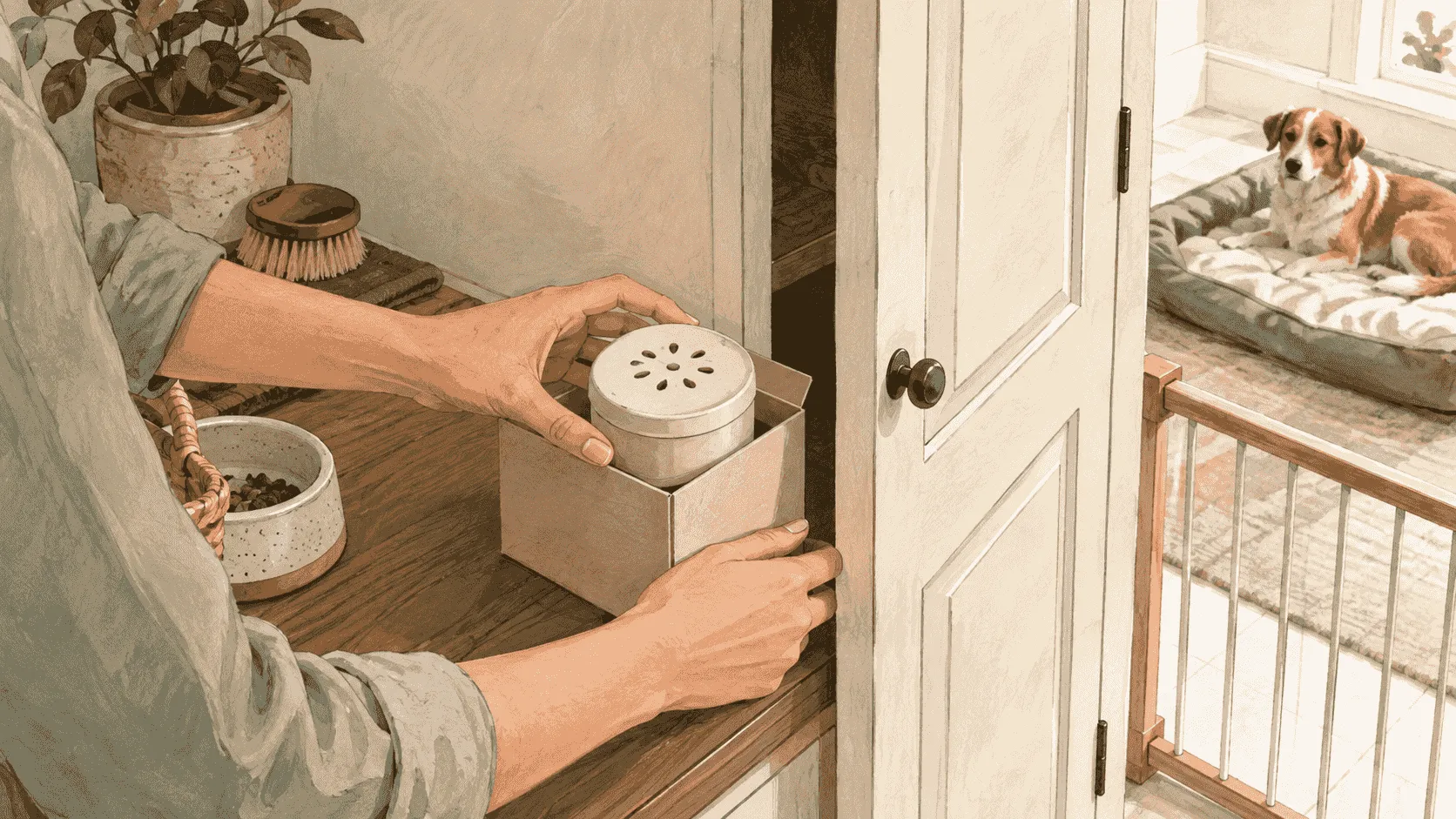
- Leave the product in its original labelled container rather than transferring it to an unmarked jar or bag.
- Put it where your dog and cat, if you have one, cannot access it. Recheck that boundary when rooms, storage, or caregivers change.
- Keep the label available. It contains product information that may matter if a professional needs to assess a possible exposure.
- Treat “keep animals away with mothballs” as the wrong use case, not as a clever storage workaround.
This is access control, not a promise that one cabinet, container, or smell threshold makes every product and home universally safe. The EPA’s pet-safety and pesticide-storage guidance supports label-led use, original-container information, and keeping pesticides out of pet reach; it does not turn those principles into one substitute label for every jurisdiction or formulation.
If your dog may have reached one
Treat possible access as a product-identity and professional-referral question. First prevent further access if you can do so safely. Then keep the original package, or take a clear photo of the full label if handling the product is safe. Contact your veterinarian, an emergency veterinary service, or an animal poison-control service promptly.
Do not try to solve the uncertainty from the generic word “mothball.” Do not use its smell, shape, color, a fragment, or the fact that your dog currently looks normal as an exposure test. The accepted evidence does not provide a safe amount, a waiting period, or a visible-sign checklist that can clear an individual dog at home.
The same boundary applies to the response itself. Do not choose a home treatment, induce vomiting, or give food, milk, water, charcoal, medication, or another household remedy unless the professional handling the case specifically directs you. The useful job for a caregiver is to preserve the product information and make the call, not to turn an internet explanation into a toxicology calculation.
Why one generic answer is not enough
The product details are not a technical footnote. Merck’s veterinary review explains why ingredients, formulations, and routes can change the toxicology question. Cornell University College of Veterinary Medicine includes mothballs among household toxins and directs an uncertain caregiver to a veterinarian or veterinary-specific poison-control center. NPIC likewise directs a suspected pet exposure toward veterinary or emergency-animal care.
Together, those sources support a deliberately narrow answer. Mothballs deserve careful access control, but a broad category cannot predict one dog’s risk or outcome. A label, package, or full-label photograph gives a professional something more useful than a guessed ingredient. It also helps separate an actual product from a similarly named household item.
This is why a normal early appearance is not a clearance rule. The source set does not validate waiting for signs, identifying a product from its odor, or deciding that a small or briefly accessible object is harmless. If you are uncertain whether access occurred, say that plainly during the call and let the veterinary professional decide what information or next step is needed.
A 60-second home check
Before there is a scare, write a short household note:
- Where are the original labelled products kept?
- Can a dog or cat reach them during cleaning, moving, renovation, or a change in routine?
- Would another caregiver recognize the package and know to keep the label?
- Do you have the veterinary clinic and animal poison-control contact details available?
If the answer to any access question changes, correct the setup and tell the people who share the home. A label-led plan also fits the broader approach in our puppy cleaning-supplies safety guide: identify the exact household product, control pet access, and preserve useful information instead of guessing from a category. For food exposures, the three-hazard dog food checklist follows the same call-before-home-treatment boundary, but mothballs need their own page because they are pesticide products rather than foods.
What this guide cannot tell you
This article cannot identify an unknown product, estimate a safe amount, predict a symptom course, set a delay, diagnose toxicosis, or provide first aid. It also does not establish a global legal or product-status rule. The government guidance in the evidence note is U.S.-specific, and labels, formulations, authorizations, and local requirements can differ elsewhere and change over time.
The professional boundary is straightforward: if your dog may have reached a mothball or moth-repellent product, keep the package or a safe full-label photo and contact a veterinarian or animal poison-control service promptly. If there has been no possible access, use the exact label for prevention and keep the product inaccessible. In both situations, the safer answer comes from the product in front of you and the dog in front of you—not from a smell test, a home remedy, or a one-size-fits-all online rule.
Sources
Petzette's claim cards for this article point to the following scientific, veterinary, or animal-welfare sources.
- Mothballs: Label-Led Pet Access Control and Exposure Referral: Cross-source evidence note combining current veterinary-school and veterinary-toxicology material with current U.S. government and university-led pesticide-safety guidance. It supports label-led prevention, preservation of exact product information, and professional referral only; it is not a product recommendation, diagnosis, dose guide, symptom checklist, home-treatment guide, or legal conclusion.
- Katan D. “Toxicosis From Mothballs in Animals.” Merck Veterinary Manual, Veterinary Professionals. Full review and last update March 2025; authored by a DVM, MPH, DABT and peer reviewed by a DVM, DABT, DABVT at the University of Minnesota. The original page rendered directly in the research browser on 2026-08-16. A command-line GET/HEAD request was blocked with HTTP 403 by the site’s automated-access policy, so this note does not claim raw-HTTP availability.